


The Current and Future Cost of Accountability
WHITEPAPER BY PSYCHED
What is the cost of no accountability? Today and for the future, the cost is much greater than a single missed deadline, an uncomfortable conversation avoided, or a poor decision left unchallenged. In the short term, the absence of accountability creates missed opportunities for feedback, learning, and course correction. It allows mistakes to be repeated, expectations to become unclear, and individuals to continue behaviors that may be limiting their growth or harming the people around them. Over time, it can also create an undeserved sense of confidence in those who are not meeting expectations, because there is no honest signal that their performance, behavior, or judgment need to change.
Societally, feedback is becoming increasingly rare. Many people avoid giving direct feedback because they fear conflict, discomfort, retaliation, or being perceived as harsh. In workplaces, families, schools, and communities, the result is often the same: lower performance, missed commitments, and harmful behavior are tolerated instead of addressed. When feedback and consequences are absent, people lose the chance to understand the impact of their actions and improve. Teams become less effective because standards become inconsistent, trust erodes, and people begin to question whether effort, integrity, and follow-through matter.
Unfortunately, the lack of accountability and corresponding consequences often benefits the low performer or poor decision-maker in the moment, while shifting the burden onto everyone else. Instead of being required to reflect, adjust, or take ownership, the individual may become more convinced that their approach is acceptable. This can inflate ego, reinforce defensiveness, and deepen what is commonly called “self-serving bias.” This occurs when someone claims personal credit for success but blames others, circumstances, timing, resources, or unfair expectations when things go wrong. Without accountability, they are less likely to admit mistakes, apologize sincerely, or recognize the damage their behavior creates.
All of this contributes to low-character and low-performing individuals gaining greater influence than they should have, both inside and outside of work. When accountability is missing, expectations are lowered to accommodate those who do not deliver, while high performers are often rewarded with more work, more pressure, and fewer boundaries. This creates resentment, burnout, and disengagement among those who consistently show responsibility. In the future, the cost becomes even more serious: cultures become weaker, relationships become more transactional, trust becomes harder to rebuild, and the standard for acceptable behavior continues to decline. Accountability is not simply about punishment; it is about clarity, fairness, growth, and protecting the people and values that allow individuals, teams, and communities to function well. Continue to get Psyched about Accountability for today and tomorrow!
Preparing the Next Generation for Family Business Leadership
Succession planning is about more than deciding who will take over a family business. A successful transition requires preparing the next generation to lead with confidence, understand the business, and earn the trust of employees, customers, and family members.
For business owners, that preparation is best started long before a leadership transition is on the horizon.
Start the Conversation Early
Conversations about succession can be difficult, especially when family relationships and business decisions overlap. However, waiting until a transition is imminent can create unnecessary pressure for everyone involved.
Start by having open conversations about the future of the business. Is the next generation interested in being involved? What role do they envision for themselves? What does the current generation hope the business looks like in five, ten, or twenty years?
These conversations don’t need to produce an immediate succession plan. Their purpose is to create clarity and make succession an ongoing discussion rather than a one-time decision.
Create Opportunities to Learn
Growing up around a family business doesn’t automatically prepare someone to lead it. Future leaders need opportunities to understand different areas of the organization and develop their own skills.
That might mean working in different departments, taking responsibility for a project, gaining experience outside of the family business, or learning directly from key employees and advisors.
Gradually increasing responsibility allows the next generation to build experience while giving the current generation an opportunity to provide support and guidance.
Build Credibility, Not Just a Title
A family name may provide an opportunity to join the business, but leadership credibility still needs to be earned.
Employees want to know that the next generation understands the organization and is prepared to lead it. Giving future leaders meaningful responsibilities, measurable goals, and opportunities to make decisions can help establish that credibility over time.
It also gives the next generation the chance to develop their own leadership style rather than simply trying to replicate the previous generation.
Make Succession an Ongoing Process
There is rarely one perfect moment to begin succession planning. The strongest transitions are often the result of years of conversations, preparation, mentorship, and gradual changes in responsibility.
For family business owners, preparing the next generation today can help protect not only the future of the company, but also the relationships and values that helped build it.
At EFBC, members have the opportunity to learn from other business owners navigating many of these same questions. Through confidential peer forums, educational programs, and a community of family business and entrepreneurial leaders, members can share experiences and gain perspective as they plan for what’s next.

Joel Spencer
EFBC President 2025-2026
EFBC Member President’s Message:
Beyond False Harmony
In the past, I have mentioned The Five Dysfunctions of a Team by Patrick Lencioni, a framework many of us in EFBC are familiar with. We explored the first dysfunction in absence of trust. Today, I want to talk about the second, which is a fear of conflict.
When trust is strong, people feel safe enough to speak their minds. But when that trust is shaky or never fully formed, teams avoid real conversations, and we settle for false harmony.
For many of us, that’s not surprising. We’ve been trained, consciously or not, to keep the peace. Don’t make waves, don’t challenge the group, and there’s often even an unspoken agreement: Don’t cause conflict for me, and I won’t cause conflict for you.
That silent agreement can feel like protection, but it’s actually a trap. Because when we avoid conflict, we avoid clarity. We dodge the truth, and that sacrifices alignment and growth.
But conflict, when it’s rooted in trust and purpose, isn’t dysfunction — it’s discipline. It’s how teams clarify what matters, it’s how we as leaders grow, and it’s how organizations break through to the next level.
So here’s what I want to offer this month:
It’s a reminder that disagreement doesn’t have to be divisive — it can be clarifying. What it means is that people care enough to be uncomfortable. It means that they’re paying attention. And the most effective leaders and the most cohesive teams don’t fear conflict. They embrace it with respect, structure, and a shared intent.
So ask yourself:
-
Is there a conversation you’ve been avoiding?
-
Is there tension hiding under the surface, pretending to be alignment?
-
Is there someone on your team who needs to know it’s okay to speak up?
At EFBC, we talk about vulnerability and growth, and this is where they meet.
Let’s keep building trust. Let’s welcome the kind of conflict that makes us stronger. And let’s keep growing as leaders, even when the conversations are hard.
Thank you for being part of this community.
I’ll see you soon.
Joel Spencer
EFBC President 2025-2026
At a recent EFBC event featuring communication expert Colette Carlson, we explored many of these same themes around communication, trust, and psychological safety in leadership teams.
A few insights that stood out:
• Only 26% of leaders are actively creating psychological safety for their teams.
• Google’s Project Aristotle identified psychological safety as the number one predictor of high-performing teams.
• Teams with high levels of trust consistently demonstrate stronger collaboration, innovation, and engagement.
As Colette shared during the event:
“How we receive someone’s truth determines if we will ever hear from them again.”
Creating space for honest conversations is not always comfortable, but strong teams are built when people feel safe enough to speak openly, challenge ideas respectfully, and work through conflict together.



Joel Spencer
EFBC President
Last week, EFBC welcomed communication expert and keynote speaker Colette Carlson for an evening focused on one of the most important challenges leaders face today: how to stay connected, communicative, and emotionally aware in a world that is changing faster than ever.
Connection Requires Intention
The conversation centered around a simple but powerful idea: connection requires intention.
As leaders, it can be easy to default to control, certainty, and assumption, especially during times of pressure or change. But throughout the evening, Colette challenged attendees to think differently. Real connection, strong leadership, and healthy workplace cultures often begin with the willingness to let go of always needing to be right or in control.
“You need to let go so others can grow.”
That message resonated deeply with many in the room, particularly in the context of family and entrepreneurial businesses where leadership can become closely tied to identity, habits, and long-standing ways of operating.
Colette encouraged attendees to examine how self-awareness shapes communication.
“Our way isn’t always the right way,” she shared. “It’s just another way.”
That mindset creates room for curiosity, stronger collaboration, and more meaningful conversations across teams and generations.
The “Many Hats” Leaders Carry
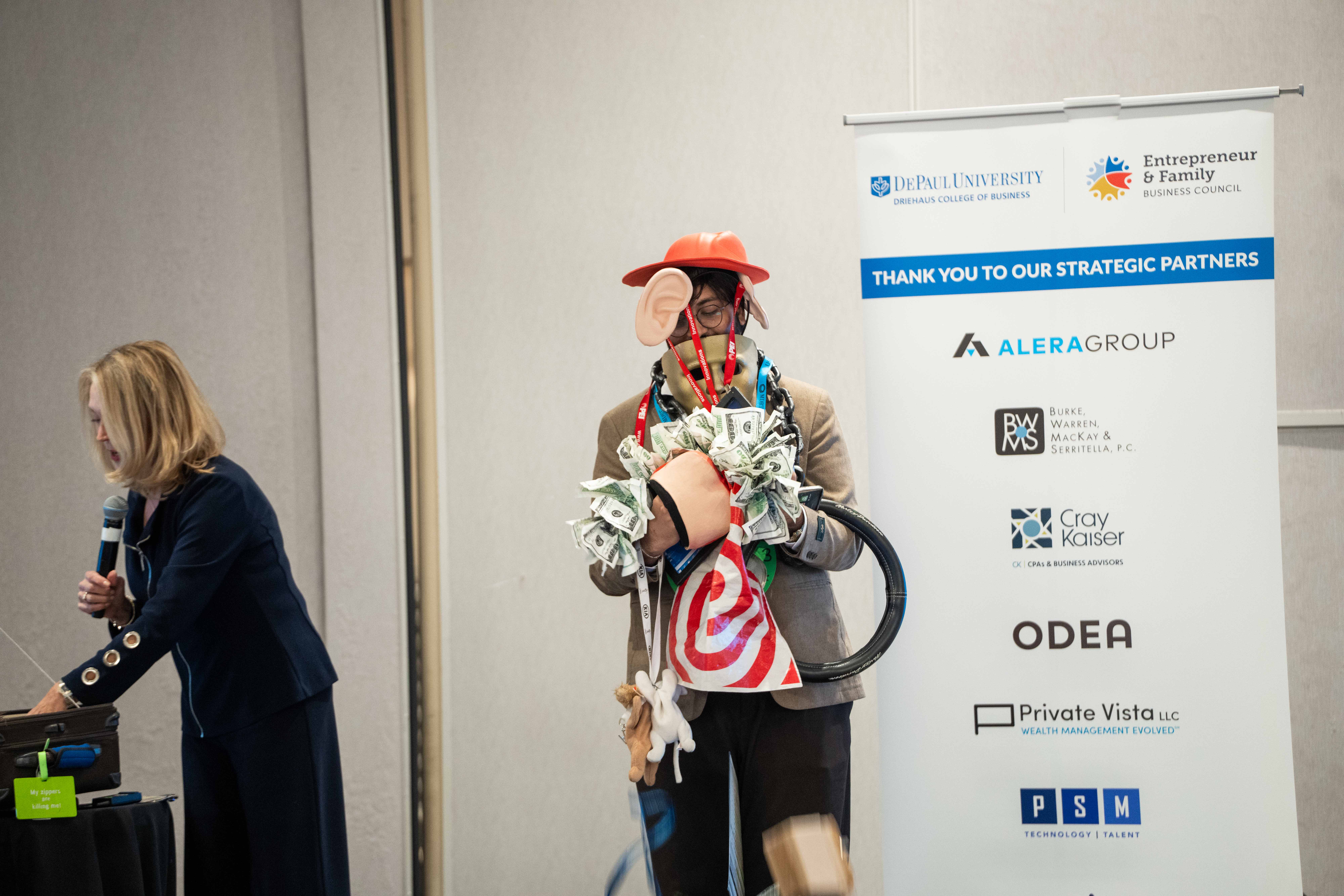
One of the most memorable moments of the evening came during an interactive exercise involving EFBC intern Luv, who volunteered to participate in a visual demonstration on leadership pressure and communication.
As responsibilities, expectations, interruptions, and competing priorities continued to pile on throughout the exercise, the audience laughed in recognition at how accurately it reflected the realities many leaders experience every day while “wearing many hats.”
The activity served as a reminder that behind every leadership role is a person often carrying far more than others realize. It also reinforced one of the evening’s larger themes: leaders who communicate intentionally and create supportive environments help prevent that weight from becoming isolating.
Creating Psychological Safety
A major focus of the discussion was psychological safety and the role leaders play in creating environments where people feel safe to speak honestly, contribute ideas, and communicate openly.
Referencing Google’s Project Aristotle research on high-performing teams, Colette shared that only 26% of leaders are actively creating psychological safety for their teams.
The takeaway was clear: leadership today is less about people “watching their back” and more about creating cultures where employees feel others “have their back.”
Colette also emphasized that how leaders respond to honesty and vulnerability directly impacts whether employees continue speaking up in the future.
“How we receive someone’s truth determines whether we will ever hear from them again.”
For leaders, that means creating workplaces where honesty is met with openness rather than defensiveness, and where people feel respected enough to continue contributing ideas, feedback, and concerns.
Communicating Through Change
Another important theme throughout the evening was communication during change.
As businesses continue navigating rapid technological shifts, evolving workplaces, and growing demands on leaders, many attendees connected with Colette’s reminder that:
“The pace of change has never been so fast, and it will never be this slow again.”
In an environment where change is constant, organizations cannot simply slow down and wait for clarity before moving forward. Instead, leaders must learn how to communicate through uncertainty with transparency, empathy, and intention.
Colette emphasized that awareness gives leaders the ability to choose curiosity over assumption, and that asking thoughtful questions is often more valuable than immediately having answers.
Leading with Intention
The evening sparked thoughtful conversations among EFBC members and guests and served as a reminder that strong leadership is not only about strategy or results. It is also about self-awareness, communication, trust, and the ability to create genuine human connection within organizations.
Thank you again to Colette Carlson for an engaging and meaningful evening with the EFBC community.
Beyond the Family Network
Stepping into a leadership role within a family business comes with a unique set of opportunities and challenges. Along with the business itself, many next-generation leaders inherit relationships that have been built over decades with clients, vendors, advisors, and community partners.
Those relationships are incredibly valuable. They are often part of the reason the business has grown and lasted across generations. But as businesses evolve, leadership evolves with them, and so should the network surrounding them.
Many next-generation leaders eventually find themselves asking the same question: How do I build my own network while still honoring the relationships that came before me?
There is no single answer. Some leaders want to preserve the business exactly as it has always operated, while others hope to introduce new ideas, new strategies, or a different direction for growth. Most fall somewhere in between. Regardless of the path, building relationships outside of your immediate family circle is an important part of growing into leadership.
Start with the Relationships Already in Place
One of the biggest advantages of a family business is the foundation that already exists. Longstanding relationships with employees, customers, suppliers, and advisors often carry years of trust and shared history.
Before trying to build something entirely new, take time to understand those relationships. Learn how they were built, what has sustained them over time, and where there may be opportunities to strengthen them further. Ask questions, stay curious, and spend time listening to the people who helped shape the business.
At the same time, it is important to remember that trust is not automatically transferred from one generation to the next. Building your own credibility matters. People want to know who you are, how you lead, and what you value.
Build Relationships Outside the Business
For many next-generation leaders, some of the most valuable relationships are the ones built outside the company itself.
Joining peer groups, attending industry events, and participating in leadership organizations can help expand your perspective and introduce you to people facing similar challenges. These connections often lead to stronger ideas, new opportunities, and relationships that continue long after an event ends.
Connecting with leaders outside your immediate circle can also help you step out of the day-to-day mindset and think more strategically about the future of your business and leadership.
Use Technology to Stay Connected
Technology has made networking more accessible than ever, especially for younger leaders looking to expand their reach.
Platforms like LinkedIn can help you stay connected to industry conversations, build relationships with professionals outside your immediate market, and engage with thought leaders in your field.
Set aside time regularly to reconnect with peers, engage with relevant content, or attend virtual events and webinars. While digital networking should never replace genuine relationships, it can be a useful tool for maintaining and growing your network over time.
Seek Mentorship
Mentorship can be especially valuable when navigating the transition into leadership within a family business.
Experienced mentors can offer perspective on challenges that are difficult to learn from a textbook, whether that involves leadership transitions, communication between generations, company culture, or balancing business decisions with family dynamics.
Consider building relationships with mentors both inside and outside your industry. Different perspectives can help you grow as a leader and navigate challenges with greater confidence.
Stay Connected to Your Community
Family businesses are often deeply connected to the communities they serve. Supporting local organizations, participating in community initiatives, and investing in relationships outside the business can strengthen both your reputation and your network.
For many businesses, community involvement is not just about visibility. It is about continuing the trust and relationships that previous generations worked hard to build.
Over time, those relationships often become some of the most meaningful and valuable connections a business can have.
Building a Network That Lasts
Building your own network within a family business is not about replacing the relationships that came before you. It is about building on them while creating connections that reflect your own leadership, perspective, and vision for the future.
The strongest networks are built over time through trust, consistency, and meaningful relationships. And for next-generation leaders, those relationships can become one of the most valuable parts of both personal and professional growth.
Looking to Grow Your Network Alongside Other Business Leaders?
The Entrepreneur and Family Business Council (EFBC) connects family and entrepreneurial business leaders through peer Forums, educational events, and meaningful relationships built on shared experience and trust.
Whether you’re stepping into leadership, navigating transition, or looking to expand your perspective beyond your business, EFBC offers a community of leaders who understand the unique dynamics of family and entrepreneurial businesses.
Joel Spencer
EFBC President 2025-2026
Why Business Leaders Need Space to Think Out Loud
Leadership asks a lot of people. It asks for vision, decisiveness, composure, and the ability to keep moving even when the path is not fully clear. What it rarely gives back is a place to process out loud.
That is one of the quiet challenges of leading a business. Not the meetings, not the decisions, not even the pressure itself, but the fact that many leaders have nowhere to bring the thoughts that are still taking shape.
At EFBC, members find more than a network. They find a trusted space to think more clearly, speak more honestly, and gain perspective from peers who understand the weight of leadership firsthand.
The Quiet Weight of Leadership
As a leader, you are often the one others rely on. Your team looks to you for directions. Your family may look to you for stability. Your business depends on your judgment.
That responsibility can make it harder to be open about uncertainty. The doubts, the unfinished ideas, and the decisions that still need time to unfold often stay unspoken. Not because they do not matter, but because there are very few places where a leader can say them out loud without any consequences.
So, you carry them. And over time, that weight adds up.
As one of our EFBC members reflected:
“You don’t oftentimes have someone to bounce things off of; I could probably make a list of about a dozen things that keep me up at night”
Not Every Room Is Built for Real Thinking
Most leaders are surrounded by people, but what they often are missing is the right room.
A conference can offer energy. A networking event can offer conversation. But real reflection needs something more. It needs trust, confidentiality, and the kind of consistency that allows people to stop performing and start being honest.
As our member, Adriana Osorio of Osorio Metals shared:
“Each member once a month presents and we do a lot of problem solving. We give feedback. Everything is confidential.”
That is what EFBC’s Forum experience is built for. This is where small groups of peers meet regularly in a confidential setting where members can bring real business and personal challenges into the room.
Thinking Out Loud Is Where Clarity Begins
Sometimes leaders do not need advice; they need space to hear themselves think.
There is something powerful about saying a challenge out loud to the right people. It can bring shape to something that felt unclear before. It can expose what is really driving a decision. It can turn pressure into perspective.
At EFBC, members do not tell one another what to do. Rather, they share experiences, offer perspective, and help one another see more clearly. That is what makes the conversation so valuable. It is not about prescriptions; it is about clarity.
As one of our members explained:
“You will learn more when you share your struggles and get more insight and tools to solve the problem”
What Only a Peer Can Offer
A consultant may bring expertise. A coach may bring a process. A peer brings something different: the credibility of having lived through something similar.
EFBC members come from different industries, different business sizes, and different stages of leadership. But they all understand what it costs to carry responsibility. That shared understanding changes the quality of the conversation.
When someone in your Forum has faced a family business challenge or a growth decision without a clear answer, their perspective does more than inform you. It helps you think better.
Brian McIlwee, an EFBC member since 1998, put it this way:
“It’s amazing how different the businesses are, and how all the problems are the same.”
More Than a Network
What makes EFBC meaningful is not just that members connect. It is that they can show up honestly.
They can bring questions that are not fully formed yet. The challenge they have been carrying quietly. The decision that still feels unfinished. And instead of having to defend it or solve it on the spot, they can think through it with people who understand.
That kind of space changes leaders. It leads to clearer decisions, stronger self-awareness, better relationships, and growth that extends beyond the business itself.
Bob Giamanco of 2XL Corporation (EFBC Member Since 2016) reflected:
“EFBC brought me shared experiences with other members that really moved the needle for my business and created meaningful growth both personally and professionally.”
As Brian McIlwee said:
“It’s like having a board of directors not just for the business, but for life.”
That is the heart of EFBC: not just a peer network, but a place where leaders can stop performing, start reflecting, and find their way forward.