


What Employers Really Look For: Lessons from EFBC’s HR Panel
Hiring looks different today than it did even a few years ago. Between remote work, shifting expectations, and new generations entering the workforce, both employers and applicants are figuring out what really makes someone stand out.

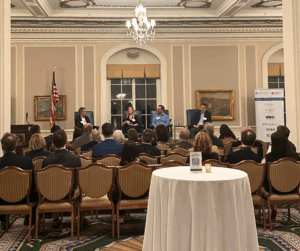
On October 29, EFBC partnered with the Coleman Entrepreneurship Center at DePaul University for an HR Panel at the Union League Club of Chicago. The conversation brought together business leaders, HR professionals, and students to explore hiring, communication, and culture in a rapidly changing world.
Moderator George Karavattuveetil, President and Founder of Psyched LLC, guided the discussion with panelists Allison Hermanek (HR Director, Cotter Consulting), David N. Avdul, PhD (Interim VP for Human Resources, DePaul University), and Luis Jimenez-Castillo, PhD (Clinical Professor, Department of Management & Entrepreneurship at DePaul).
Trust Over Supervision
For companies that operate remotely, trust has become the foundation of success. Allison Hermanek shared that for her team at Cotter Consulting, traits like timeliness and reliability are essential. Without in-person oversight, these small actions build the confidence that keeps projects moving smoothly.
Moderator George Karavattuveetil noted how different that is from traditional management, where leaders could monitor their teams directly. In a remote setting, success depends less on supervision and more on mutual accountability between leaders and employees.
That trend reflects the broader workforce: nearly 23% of U.S. employees telework at least part-time, according to the Bureau of Labor Statistics. Remote work has shifted the emphasis from presence to performance, forcing both employers and applicants to rethink what trust and productivity really look like.
Communication and Connection Still Matter Most
Luis Jimenez-Castillo highlighted the importance of interpersonal skills—especially as communication increasingly happens through screens. He discussed how technology and the pandemic have weakened some in-person skills, while also creating new opportunities for collaboration across distance.
For employers, that means valuing candidates who can balance both worlds: comfortable with technology but also confident in human connection. For students and early-career professionals, it’s a reminder that communication, negotiation, and creative problem-solving remain timeless strengths.
Recent data supports that shift. The World Economic Forum projects that by 2030, nearly 40% of workers’ skill sets will change, with social and analytical abilities becoming some of the most in-demand traits.
Skills That Still Set You Apart
David Avdul spoke about how technical expertise continues to help candidates stand out. Even as automation expands, being fluent in technology signals adaptability and a willingness to learn.
At the same time, all three panelists agreed that curiosity, initiative, and growth-mindedness matter just as much as experience. Research backs this up: more than 80% of employers use some form of skills-based hiring, and those who do report higher retention and better job performance.
Recruitment Strategies that Work
The panel also explored how companies can strengthen their recruitment and onboarding processes. Allison Hermanek shared how Cotter Consulting takes a comprehensive, people-first approach that starts well before a new hire’s first day. Recruiters share one central calendar for all career fairs, community events, and hiring activities, ensuring the entire team stays aligned.
Once new hires accept an offer, Cotter keeps the momentum going with personal touches that build connection early on. Before their start date, new employees receive cookies at home, a small gesture that, according to exit interviews, makes them feel welcomed and valued. Cotter also encourages in-person onboarding where employees meet multiple departments, fostering cross-team connection and trust from the beginning.
George Karavattuveetil reminded attendees that strong recruitment starts even earlier, with the job description itself. The language used in that first step helps set expectations and shape the candidate’s perception of company culture. Clarity and authenticity can attract candidates who genuinely align with the organization’s values.
The Role of AI in Recruiting
When the discussion turned to AI, David Avdul noted that while it can be an efficient tool, it should never replace the human element of hiring. AI is best used to streamline administrative tasks, not to take over human interaction or decision-making.
George Karavattuveetil added that every step of the hiring process should be evaluated from the candidate’s perspective. Employers should ask themselves whether each step leaves a positive impression. If the answer is yes, AI is being used effectively. If not, it may be time to rethink how it fits into the process.
A Night of Insight and Connection
After the panel, guests stayed for a networking reception featuring appetizers, drinks, and free professional headshots for students. The room buzzed with conversation between DePaul students, faculty, and local business owners, each learning from the other’s perspective.
The evening was a reminder that while hiring practices may evolve, the core ingredients for success—trust, communication, and curiosity—remain constant.